If you have ever stood in a preschool lobby reading a wall of certificates and wondering which ones really matter, you are not alone. Parents often ask me whether they should prioritize a licensed preschool or hunt for an accredited preschool. The short answer is that licensing and accreditation serve different purposes. Licensing is the baseline that keeps children safe, and accreditation is a voluntary step that aims to raise the bar on quality. The long answer is more nuanced, and worth walking through carefully, especially if you want a quality preschool program that fits your child’s temperament, your family rhythms, and your hopes for a strong start to school.
I have toured programs that are beautifully accredited and feel sterile, and licensed programs run by seasoned educators that hum with warmth and curiosity. I have also seen the opposite. Paperwork alone will not tell you whether your 3-year-old will be comforted during the first teary drop-offs or whether your 4-year-old will get the scaffolding needed to sound out early words without losing their joy in stories. It helps to understand what each designation means, what it does not mean, and how to spot a fit for your child.
What licensing guarantees, and what it does not
Licensing is the state’s way of saying this preschool meets minimum health and safety standards. The exact rules vary by state, but you typically see requirements around staff background checks, ratios and group sizes, immunization tracking, building safety, sanitation, and sometimes a basic training threshold for teachers. In my state, for example, a licensed preschool must keep ratios such as 1 adult to 8 preschoolers, with group sizes capped between 16 and 24 depending on age. Inspectors visit, sometimes unannounced, to verify compliance.
What licensing does not tell you is the richness of the preschool curriculum or whether teachers are trained in early childhood preschool development beyond the basics. A licensed preschool can be bare-bones on the learning side and still pass inspections. I once visited a fully licensed center where the schedule looked like this: long blocks of “free play,” occasional teacher-led crafts, then outdoor time. The children were safe, but the interactions felt reactive rather than intentional. No clear preschool learning program, few opportunities for language development, and little differentiation for children who needed more support or more challenge.
If your baseline priority is safety, a licensed preschool is the starting point. If you want a structured preschool environment that nurtures social-emotional growth and builds foundational skills for kindergarten, licensing alone will not guarantee it. You will need to ask more questions.
What accreditation adds to the picture
Accreditation is voluntary and provided by a third party. In early childhood, the most recognized bodies in the United States include the National Association for the Education of Young Children (NAEYC), Cognia, and state-level quality rating systems that go beyond licensing. Accreditation typically evaluates program philosophy, teacher-child interactions, family engagement, assessment practices, curriculum alignment, and continuous improvement. The process is not trivial. Programs complete a self-study, gather evidence, and host evaluators who observe classrooms and review documentation. Reaccreditation happens on a cycle, usually every 3 to 5 years.
When I walk into an accredited preschool, I expect to see intentionality. Teachers narrate children’s thinking and extend it with open-ended questions. The preschool program usually has a coherent scope and sequence, plus a system for tracking each child’s growth. Family communication goes beyond newsletters to include conferences with portfolios, and there is a plan for professional development. It does not mean the learning is academic in a heavy-handed way. In fact, the best accredited programs lean into a play based preschool approach while weaving in literacy, math, and science experiences that are developmentally appropriate.
Accreditation also has limits. I have known accredited preschools that struggled to retain lead teachers. The framework was strong, but the day-to-day experience varied by classroom. Accreditation is a good proxy for quality, not a guarantee of magic. You still need to visit.
Why the difference matters for your child
A 3-year-old and a 4-year-old live in different worlds. A preschool for 3 year olds should focus on attachment to teachers, language explosion, sensory play, and early peer skills like waiting, sharing, and reading facial cues. A preschool for 4 year olds often leans toward a pre kindergarten program, building stamina for group learning, introducing phonological awareness, number sense, and early problem solving while continuing to prioritize social skills. Licensing does not address that nuance. Accreditation frameworks often do, because they evaluate age-specific practices and differentiated supports.
Children also bring their own profiles. I think about a little boy I worked with who loved gears and building. In the right early learning preschool, he thrived when teachers used his mechanical interests to introduce patterns, measurement, and vocabulary. In a less structured classroom, he hoarded the gears, clashed with peers, and became “the kid who causes trouble.” The same child, two different environments. The presence of a thoughtful preschool curriculum and trained teachers made all the difference.
What “Program-Focused” looks like in practice
Quality programs are intentional about the how and the why of their preschool education. In a program-focused setting, the day has a rhythm: arrival rituals that calm, morning meeting with conversation, small-group work tied to specific goals, long stretches of purposeful play, outdoor exploration, and closing routines that help children make meaning of the day. The best classrooms use a preschool readiness program that blends child-led exploration with educator guidance. Teachers observe, document, and adjust. They set up provocations that invite inquiry, like ramps and balls to explore motion, or a dramatic play area transformed into a post office to practice symbols, writing, and community roles.
Play based preschool does not mean anything-goes. Play is the vehicle, and the route is planned. If the current project is insects, you might see magnifying tools, nonfiction picture books, a chart of insect body parts, and an art station with model clay to build segmented bodies. Teachers might introduce math words like “compare,” “more,” and “equal” as children sort beetles by size. In an accredited preschool, the teacher can explain how these experiences align to a preschool learning program framework and how they support the pre k preschool goals for literacy, math, and social-emotional development.
Staffing, ratios, and training
Parents often ask about ratios and teacher credentials first, and for good reason. Licensing sets legal minimums, such as 1 to 10 in some states for preschool-age children. Accredited programs often commit to lower ratios, such as 1 to 8 or even 1 to 6 in developmental preschool classrooms that serve mixed needs. Lower ratios allow teachers to observe subtle cues, coach social skills in the moment, and differentiate instruction.
Training is another fork in the road. Licensing may require introductory hours in childcare health and safety and a handful of professional development hours each year. Accreditation typically expects more: degreed lead teachers or a plan to support staff toward degrees, specialized training in child development, and ongoing coaching. If a teacher can tell you how they support phonological awareness without formal worksheets, or how they scaffold a shy child into group play, that is a strong sign of expertise.
Turnover matters too. Preschool is relational. High churn can stall progress and unsettle children. Ask centers for their annual turnover rate. A stable team suggests that leadership invests in mentoring, planning time, and a structured preschool environment where teachers can do their best work.
Curriculum without worksheets
Parents sometimes expect a stack of worksheets as evidence of learning. In early childhood, that expectation can backfire. A quality preschool program builds foundational skills through hands-on experiences and language-rich interaction. Reading readiness is not memorizing sight words at age four. It is hearing and playing with sounds, recognizing rhymes, clapping syllables, and developing a love of stories. Math readiness is not filling in numerals on a page. It is one-to-one counting with real objects, comparing sets, subitizing small quantities, and talking through how to solve problems.
In the strongest programs I visit, teachers collect authentic work samples and photos that capture learning in action: a child’s invented spelling next to a drawing of a spider, a tower plan sketched by a pair of four-year-olds, a tally sheet from a nature walk. The preschool curriculum is visible, but not in a way that overloads children with seatwork. Accreditation encourages these practices and asks programs to explain how they assess progress. Licensing does not typically wade into that depth.
Special considerations for developmental preschool
If your child has a speech delay, sensory differences, or an individualized education plan, you will want a preschool that understands how to blend therapy goals into daily routines. Developmental preschool classrooms, often run by school districts, are staffed by special educators and related service providers. Some community-based programs are inclusive, mixing typically developing peers with children who have identified needs. Inclusion, when done well, benefits everyone by normalizing differences and widening the range of social models.
Accredited programs are not automatically better for children with unique needs, but accreditation often requires explicit plans for inclusion and collaboration with specialists. Licensing ensures legal compliance around accessibility and safety, but it does not evaluate the quality of team-based support or whether teachers can adapt the environment for sensory needs.
What parents should look and listen for on a tour
I have toured hundreds of classrooms, and the first minute tells me a lot. Watch how teachers greet children. Do they crouch to eye level and use names? Listen for language that extends thinking: “You sorted by color. What else could we try?” Peek at the classroom at rest: Are materials accessible in labeled bins? Are there cozy spaces for children who need downtime? Ask about outdoor time. Many states require a minimum number of minutes, but the best programs treat the outdoors as an extension of the classroom, not just a break for recess.
Look for documentation. On the wall, you should see more than commercial posters. You want evidence of the preschool learning program in action: children’s words transcribed near their work, portfolios with dated samples, and a plan for parent-teacher conferences. If the school claims a structured preschool environment, ask them to walk you through a typical day and the purpose behind each component.
Finally, pay attention to the emotional climate. I would rather enroll a child in a licensed preschool with warm, skillful teachers and a thoughtful daily rhythm than in a paper-perfect accredited preschool that feels cold or chaotic. That said, when warmth meets accreditation-level intentionality, you have the sweet spot.
Cost, hours, and the hidden variables
Accreditation can add to operational costs, which may show up in tuition. It is not a law, but I often see accredited programs priced 5 to 20 percent higher than comparable licensed-only programs in the same neighborhood. Before you stretch the budget, consider what you truly gain. Extended hours can matter just as much, especially for working families. Some accredited preschools operate school-day schedules that end early afternoon. If you need full-day care with wraparound coverage, a high-quality licensed preschool might suit your logistics better.
Hidden variables include the calendar (year-round vs school-year), teacher planning time (which affects burnout), and the school’s approach to illness policies. After 2020, many centers tightened health policies. Ask how they handle mild symptoms and what their communication looks like. Licensing sets minimum health protocols. Accredited programs often go beyond, but practical flexibility can be just as important to families.
How play-based and academic priorities coexist
I occasionally hear a false choice between play and academics, as if play means “no learning” and academics mean “sit still.” In a well-designed early learning preschool, these priorities coexist. You see a block area where children plan, build, and revise, which builds spatial reasoning tied to later math achievement. You hear teachers modeling complex vocabulary and syntax, which feeds language development and later reading comprehension. You notice a writing center with different media for mark making, messages, and labels, which lays groundwork for phonics and composition.
Accreditation tends to favor these child-centered practices because research supports them. Licensing does not pick a side. A licensed preschool can be drill-heavy or laissez-faire. Your job is to match your child. A highly energetic child might thrive in a classroom with long stretches of outdoor exploration and movement games that build executive function. A reflective child who loves pattern and structure may enjoy small-group math provocations and sequence-based storytelling. Neither choice is inherently better. The best preschool program is the one that takes your child seriously as a learner, without rushing childhood.
Real-world examples from the field
A few years back, I worked with two centers two blocks apart. Center A was licensed, family-run, staffed by two veteran teachers and two assistants. Ratios hovered around 1 to 7. The day started with a warm arrival, followed by small-group literacy games and a nature walk in all seasons. Their preschool readiness program was homegrown but thoughtful. Portfolio conferences were personal. Parents raved about the community. Center B was accredited by a national body, with a published curriculum and a formal assessment cycle. The classrooms were gorgeous. Teacher turnover, however, had crept up, and by spring children had cycled through three different assistant teachers.
Which was better? It depended on what the family valued. For a child who needed the structure and continuity of a clearly mapped pre k preschool pathway, Center B delivered, especially in the hands of a strong lead teacher. For a child with separation anxiety who needed the same faces and flexible routines, Center A was the safer bet. Both were good, just in different ways. The lesson: use licensing and accreditation as guides, then weigh the human factors.
Questions to ground your decision
Use the list below as a focused tool during tours and calls. It helps families cut through marketing language and get to the heart of program quality.
- How do you describe your approach to preschool education, and how does it look in a typical day for 3-year-olds versus 4-year-olds? What training do lead and assistant teachers have in early childhood preschool development, and how do you support ongoing professional growth? How do you assess children’s learning and share progress with families without relying on worksheets? What are your teacher-child ratios, and how do you handle staffing when someone is out? Can you share an example of how you supported a child who struggled socially or needed extra challenge in your preschool learning program?
If a director can answer these with specificity and warmth, you are on the right track.
The role of family partnership
Quality preschools see families as partners, not clients. That means transparent communication, not just at enrollment but week by week. Accredited programs often formalize this through conferences, family surveys, and invitations to observe learning. Licensed programs can do this too if leadership values it. Look for signs of true partnership: teachers who know your child’s interests, a director who responds quickly to concerns, and a culture that welcomes caregivers into the classroom occasionally, even if briefly.
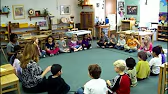
I think of a mom who worried that her 4-year-old was not “reading yet.” The teacher invited her to observe small-group time. She watched her child segment and blend sounds while giggling through a puppet show. The worry softened. Good communication is not just data, it is context.
What to expect for transitions to kindergarten
A strong pre kindergarten program does not try to replicate kindergarten, it prepares children to thrive when they get there. That means practical skills like managing a backpack and lunchbox, recognizing their name, and sustaining attention for short group lessons. It also means resilience: asking for help, trying again, handling disappointment, and making friends. When a preschool invests in these habits, the leap to kindergarten feels natural rather than abrupt.
Accredited programs often stay in touch with local elementary schools and align their expectations. Some licensed preschools do this as well, especially those led by educators with district experience. Ask how the program supports transitions. Do they send portfolios? Do they invite kindergarten teachers to speak to families? Do they practice cafeteria routines and bus safety? These details matter.
How to balance ideals with real life
It is easy to build a wish list that no single school can meet: accredited, low ratios, full-day coverage, close to home, affordable, diverse, outdoor-focused, with a music studio and chef-prepared meals. Real life requires trade-offs. I encourage families to pick two or three non-negotiables and hold the rest lightly. If your child has asthma, strong health protocols and outdoor air quality plans might top the list. If your child is a dual-language learner, look for a preschool program that supports bilingual development with intention. If you work long hours, reliable coverage may outrank accreditation.
Remember, your child’s experience will be shaped most by the teacher in the room. A licensed preschool with a gifted lead teacher can outshine an accredited preschool with an overextended team. And yet, accreditation stacks the odds in favor of strong systems that support those gifted teachers.
A quick side-by-side snapshot
Use this brief comparison as a memory aid after tours. It is not exhaustive, daycare safety tips but it captures the core difference.
- Licensed preschool: State-issued approval focused on health, safety, and legal compliance. Baseline ratios and training. Curriculum and teacher development vary widely by site leadership. Accredited preschool: Voluntary quality mark from a third-party body. Evaluates curriculum, interactions, assessment, family engagement, and continuous improvement. Often lower ratios, deeper training, and stronger systems.
If you keep that distinction in mind, the rest of your decision becomes a matter of fit.
Final thoughts from the classroom floor
When I picture a thriving classroom, I hear the low buzz of children at work, not a director reciting credentials. I see a teacher kneeling next to a child, whispering, “Tell me about your plan,” and then stepping back as the child tries, fails, adjusts, and beams. I see a shelf of well-loved books, magnifying glasses smudged with fingerprints, clipboards with child drawings layered over dictated stories, and a schedule that bends when a moment invites deeper inquiry.
Licensing keeps that room safe. Accreditation pushes the program to design that room with purpose and to keep learning from year to year. Your visit and your questions reveal whether the people in the room can translate safety and purpose into joy for your child. If you find that, whether the sign says licensed or accredited, you have likely found your place.